Every summer the same thing happens, and every summer it gets explained the same wrong way.
You did a twist-out. It was beautiful for about four hours. Then you stepped outside and by the time you arrived anywhere it had expanded into something you did not style. And the explanation on offer is always some version of your fault: wrong product, not enough gel, hair too damaged, moisture barrier compromised.
The measurements say something else. Your hair is doing a thing that straight hair, tested under the same conditions, does not do. That is not damage. It is a property, and researchers only recently caught it happening.
The bond that runs your whole styling routine
Start with why any style holds at all.
Hair keratin is held in shape by several kinds of bond, and a 2024 review in the International Journal of Cosmetic Science puts the ratio at roughly nine hydrogen bonds for every one disulfide bond. Disulfide bonds are the strong ones. They are what relaxers and perms break, which is why those changes are permanent. Hydrogen bonds are weak, enormously numerous, and the review is direct about what water does to them: moisture absorption reduces the number of hydrogen bonds actually doing anything, and in wet conditions they are considered close to entirely cancelled out.
That single fact runs your entire styling routine, whether or not anyone told you.
Every temporary style you have ever done works by breaking hydrogen bonds with water, holding the fiber in a new shape, and letting it dry so the bonds reform in the new position. Twist-outs, braid-outs, roller sets, blowouts, silk presses. All the same physics. The style is water-set hydrogen bonds, and water is what undoes them.
So humidity is not attacking your style. It is doing the same thing your spray bottle does. The air is just doing it without asking.
The finding that makes this a textured hair story
Here is where it stops being general hair science.
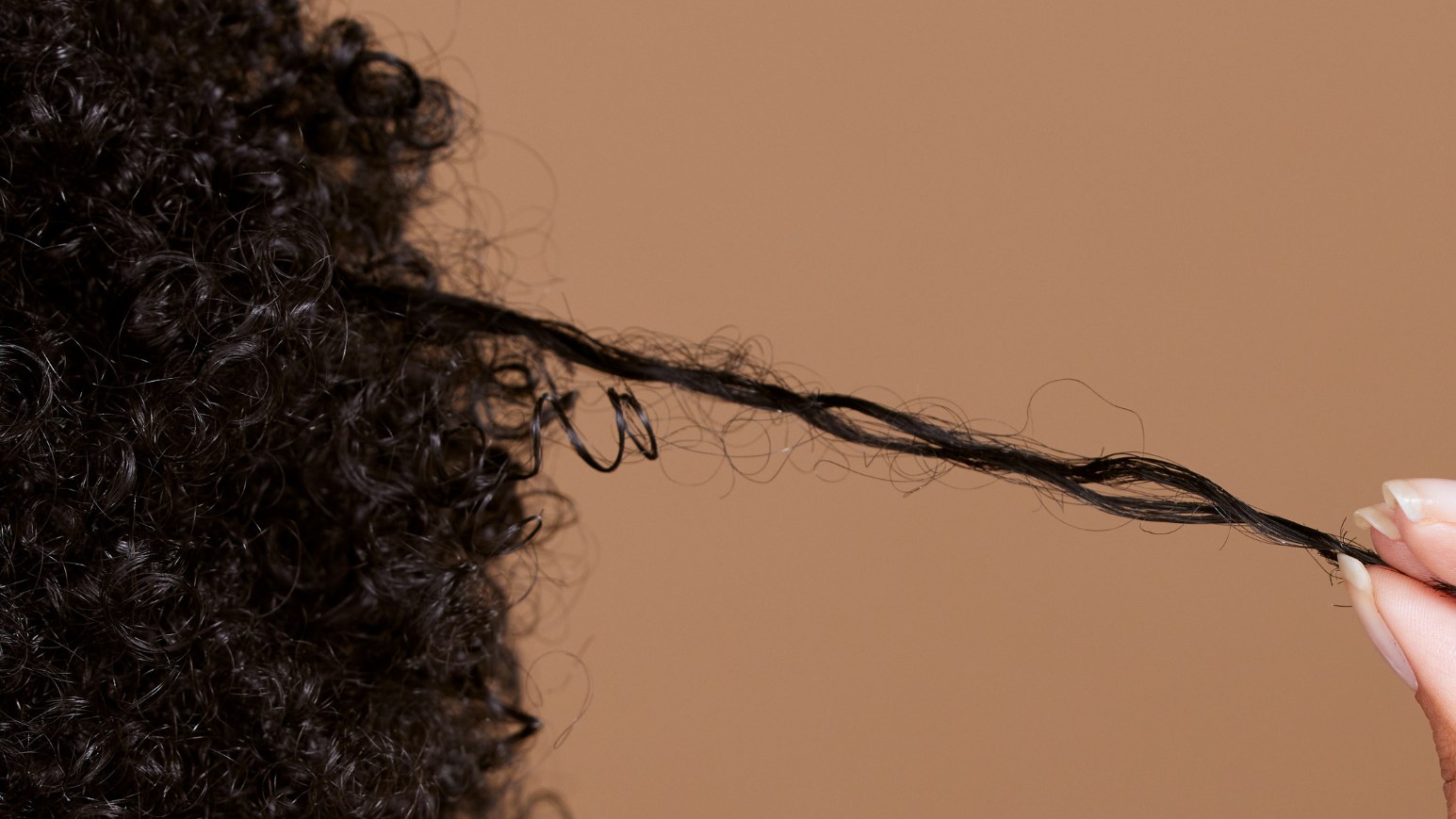
In 2025, researchers published a paper in the Journal of Investigative Dermatology reporting something they noticed while running tensile tests. They observed hydration-driven shape memory in curly human scalp hair fibers, and not in straight ones.
Same conditions. Same tests. Curly fiber changed shape in response to hydration in a way straight fiber did not.
Their proposal is that curly fiber contains an unusually extensive network of weak hydrogen bonds, arising from how amino acid residues are arranged in the matrix of the fiber. More bonds available to water, distributed differently, in a fiber whose shape depends on them more heavily.
The caution matters and the authors state it themselves. They call this preliminary evidence and describe the work as proof-of-concept. The bond network is a postulation drawn from what they observed, not a demonstrated mechanism, and this needs replication at larger scale before anyone treats it as established.
But it is the first direct measurement of the thing every woman with textured hair has known experientially for her entire life. Your hair responds to humidity differently. Not more dramatically because it is more damaged. Differently, because it is built differently.
Worth noting that the senior author is Nonhlanhla Khumalo, whose earlier work on African hair length is the basis of what we know about retention. There is a small body of researchers doing serious work on textured hair specifically, and this is what happens when they do.
Direction matters, not just level
One practical thing follows from the physics that almost nobody mentions.
Water moves toward equilibrium. So it is not only high humidity that disturbs a style. Moving from high humidity to low will pull water out of the fiber, and that movement disrupts hydrogen bonds on the way out just as arriving water does on the way in.
Which means styling in a steamy bathroom and then walking into dry air is its own problem, not a safe one. What a style prefers is stability. The closer the humidity where you style is to the humidity where you are going, the longer it holds.
That reframes summer entirely. The issue is not that summer air is wet. It is that summer air is different from your bathroom, and moving between them is what your twist-out is actually being asked to survive.
There is also a threshold worth knowing about. A 2025 study on the kinetics of moisture sorption identifies a transition around 30 percent relative humidity, where the inner structure of the fiber opens up and accommodates more water. Below that, less is happening. Above it, the fiber is genuinely taking water in. Most inhabited places sit well above 30 percent most of the time.
What about hygral fatigue
This is the term the natural hair community reaches for constantly. The idea that repeatedly wetting and drying hair causes cumulative internal damage, and that this is why your hair got frizzier over the summer.
I went looking for the evidence and could not find peer-reviewed work establishing that the damage happens. The term appears in the literature, but in the papers I could reach it is used descriptively rather than demonstrated, and I did not find a study showing that ordinary wet and dry cycling produces the internal damage the concept describes.
That is an absence, not a refutation. I cannot access everything, and something may exist that I did not reach. But it is worth knowing that the mechanism at the front of this article, hydrogen bonds and water, is thoroughly documented, while the thing most often blamed for summer frizz is not on remotely the same footing.
If the honest answer is that your hair swells and its shape changes because it is curly and the air is wet, then routines built around preventing hygral fatigue are solving for a problem that may not be doing what we think.
What to do
Style as close as possible to the humidity you are heading into. If it is going to be humid, do not set your hair in the driest room in the house and hope.
Let it dry completely before you take a style down. Hydrogen bonds set as water leaves, and unravelling a twist-out that is still damp means the bonds have not finished forming in the shape you want.
Choose styles that use the swelling instead of fighting it. Anything defined enough to look wrong when it expands is a bad bet in August. Wash-and-gos, chunky twist-outs, and styles with built-in volume have room to move.
And stop reading it as failure. The expansion is your hair doing exactly what curly keratin does in wet air, and now there is a measurement showing that straight hair, tested the same way, does not do it at all.
Your products did not fail. Your hair is just not the fiber the advice was written for.
Sources
Where a source has a limitation that affects how much weight it can carry, it is stated here rather than left out.
Breakspear S, Noecker B, Popescu C. Chemical bonds and hair behaviour: A review. International Journal of Cosmetic Science. 2024.
doi:10.1111/ics.12967View source
A review synthesising existing work rather than reporting new experiments. Covers hair fibre generally rather than textured hair specifically.
Cloete E, Ngoepe MN, Ismail E, Khumalo NP. Weak Hydrogen Bonds in Temporary Shape Changes of Curly Human Hair Fibers: Preliminary Evidence. Journal of Investigative Dermatology. 2025.
The authors describe this as preliminary evidence and proof-of-concept. The proposed hydrogen bond network is a postulation drawn from their observations, not a demonstrated mechanism. Treat the finding as a strong lead rather than settled science.
Breakspear S, Frueh P, Neu A, Noecker B, Popescu C, Uellner Q. The kinetics of moisture sorption by hair. International Journal of Cosmetic Science. 2025.
doi:10.1111/ics.13028View source
Laboratory measurement of fibre behaviour under controlled humidity. Describes what the fibre does physically and does not address styling outcomes.