There are two sentences that sound like the same advice, and they are not.
The first: textured hair does not need washing every week. The second: textured hair should be washed at least every two to three weeks.
The first is permission. The second is an instruction with a deadline attached. Most of us absorbed the first one and never heard the second, and the difference between them is where a lot of scalp trouble lives.
What the guidance actually says
The American Academy of Dermatology's advice for curly and coily hair opens exactly the way the community version does. Wash only when needed. Thick, curly hair does not need washing daily or even weekly, and washing too often leaves it dry, frizzy, and difficult to manage.
Then it adds a clause that rarely survives the trip to social media: you should wash a minimum of every two to three weeks for scalp and hair health.
Their general hair guidance repeats it. If your hair is dry, textured, curly, or thick, shampoo when needed, at least once every two to three weeks. Same phrasing. A minimum, not a maximum.
That word does a lot of work. Two to three weeks is not the outer limit of what is safe. It is the point past which dermatologists start to worry.
What we actually do
Now put real numbers next to it.
A three-year study presented to the American Academy of Dermatology found that 79.4 percent of African American women surveyed washed their hair less than once a week. Not occasionally. As standard practice.
A 2024 review in the Journal of Clinical and Aesthetic Dermatology puts finer detail on it, citing research showing that hairstyle choice largely determines washing frequency. Black women wearing natural, non-traction styles washed on average every 14 days. Those wearing braids or weaves went 18 to 32 days.
Line that up against the guidance. Fourteen days sits at the edge of the recommended window. Eighteen to thirty-two days sits outside it, in some cases at more than double.
Both of those sources carry limitations worth naming. The first is a conference abstract rather than a full paper, the study medication was supplied by a pharmaceutical company, and the washing figure is self-reported. The second is a review rather than original research, and its author works for a pharmaceutical company. Neither is disqualifying. Both are reasons to treat the numbers as a strong signal about a pattern rather than a precise measurement.
Why the advice went this direction
The push toward washing less was a correction, and it was a fair one.
For decades the standing advice was generic, built around straight hair and an oily scalp, and it did not fit. The AAD is direct that thick, curly hair is more prone to breakage and dryness than other hair types. Wash it on a schedule designed for someone else's scalp and you strip a fiber that was already struggling to hold moisture. The usual explanation is geometry: sebum travels a straight shaft easily and a tightly coiled one poorly, so the ends of coily hair stay dry while the scalp does not.
So the community worked out something the guidance had not offered, which was to wash less and moisturize more. It worked. Hair got better.
The problem is that the correction kept going. Less became as little as possible, and the number stopped being about scalp health at all. It became a badge.
Your scalp and your strands are not the same organ
Here is the part the advice collapsed.
Everything about washing less is reasoning about the hair fiber, which is dead protein that cannot repair itself and loses moisture every time it is stripped. Protecting it is legitimate.
Your scalp is living skin. It sheds cells, produces oil, hosts a microbiome, and accumulates whatever you put on it. It has the same needs as the skin on your face, and none of the reasons to wash coily hair less apply to it.
Wash frequency in the natural hair community has been optimized almost entirely for the strand, with the scalp treated as something that happens to be attached.
That shows up clinically. Seborrheic dermatitis is common in Black patients, and infrequent washing combined with heavy scalp products is a recognized aggravating factor. The flaking, itching, and tenderness that get filed under dry scalp are frequently the opposite problem: buildup, inflammation, and yeast overgrowth on skin that has not been cleaned in a month.
Which leads to the trap. Flakes appear, they read as dryness, so oil or grease goes on the scalp to fix it. That is the standard move and it is often exactly backwards. Emollients belong on the hair shaft. The scalp usually needs cleansing, not sealing.
The part where medicine fails us back
There is a second failure here, and it is not ours.
Medicated shampoos for scalp conditions are typically prescribed at two to three uses per week. That instruction assumes a person who washes their hair that often.
Handed to someone washing every 14 days, or wearing braids and washing every 30, the prescription is not difficult. It is impossible. She cannot follow it without dismantling her hair, so she uses it twice, sees no change, and concludes the treatment does not work. Her dermatologist records that the patient did not respond.
Nothing about that failure is medical. It is a dosing schedule written for a hair type the prescriber did not account for, which is the same gap that runs through most textured hair care in clinical settings. This is worth knowing before you decide a product failed you, and worth raising directly with a dermatologist who can prescribe a formulation that suits your actual routine.
What to do with this
The useful reframe is not a number. It is which part of your head sets the schedule.
Let your scalp set the floor. Two to three weeks is the outer edge, not the target, and if your scalp is itching, flaking, tender, or holding odour, that is information arriving ahead of schedule. Wash it.
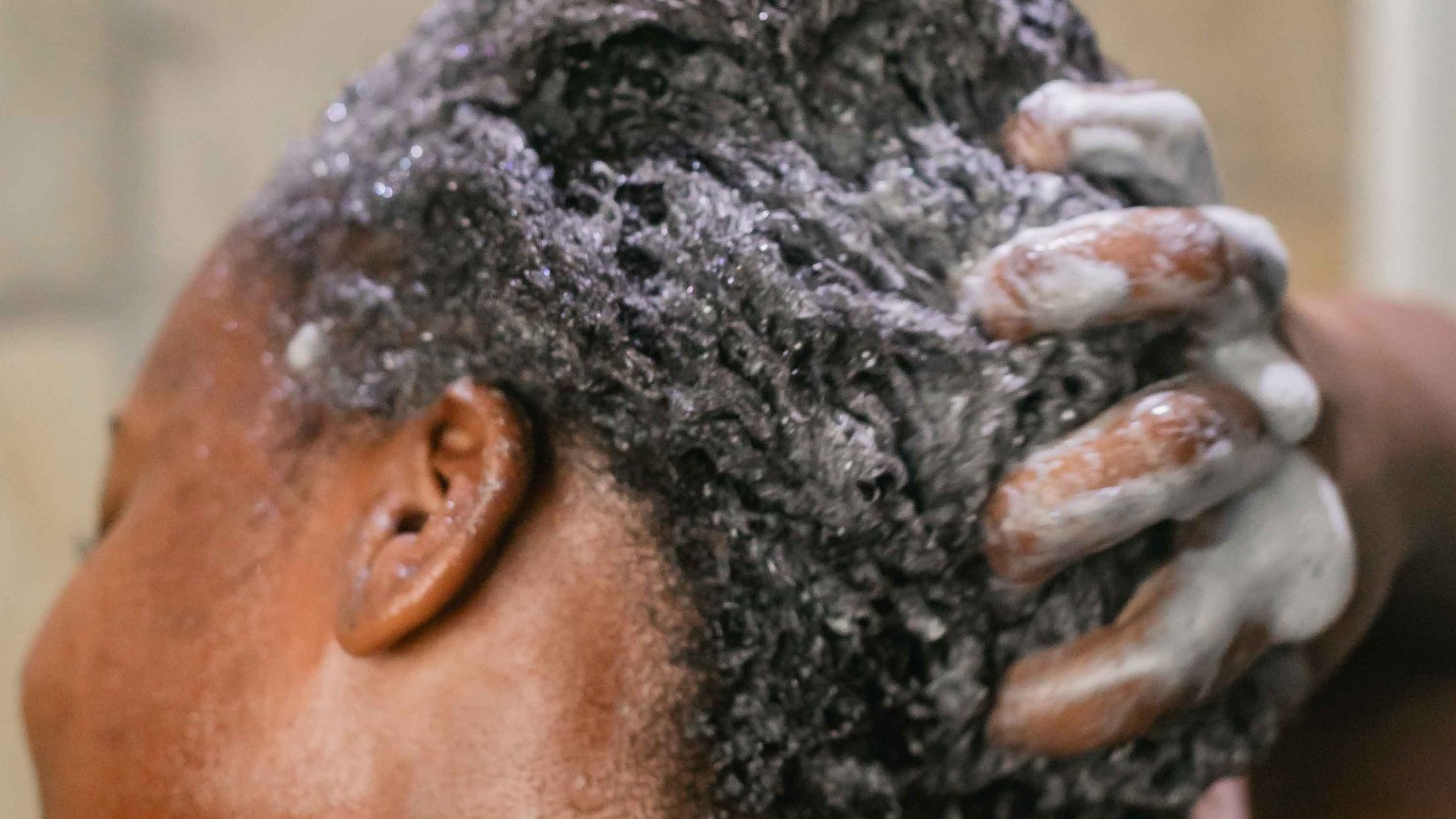
Let your strands set the technique. The answer to dryness from washing is how you wash, not how rarely. Dilute the shampoo, focus it on the scalp rather than the lengths, work in sections, and condition properly afterward. Those adjustments protect the fiber without leaving your skin uncleaned for a month.
And if you are in a protective style, plan the wash before you install it, not after you notice you need one. A style you cannot clean under is a style with a shorter working life than the one you were sold.
None of this is an argument for washing more. It is an argument that the number was never the point. Your hair was one variable in a system that also includes living skin, and the skin has been left out of the conversation for a long time.
Sources
Where a source has a limitation that affects how much weight it can carry, it is stated here rather than left out.
American Academy of Dermatology. 6 curly hair care tips from dermatologists. American Academy of Dermatology. 2022.
Patient education guidance rather than a primary study. Represents consensus clinical advice, not new data.
American Academy of Dermatology. Tips for healthy hair. American Academy of Dermatology. 2024.
Patient education guidance. Reviewed by board-certified dermatologists but not a research finding.
Chappell J, Mattox A, Simonetta C, Armbrecht E, Guo M. Seborrheic dermatitis of the scalp in populations practicing less frequent hair washing: Ketoconazole 2% foam versus ketoconazole 2% shampoo. Three-year data. Journal of the American Academy of Dermatology. 2014.
doi:10.1016/j.jaad.2014.01.222View source
Conference abstract, not a full peer-reviewed paper. GlaxoSmithKline supplied the study medication. The washing-frequency figure is survey self-report.
Sangha AM. Approach to Treating Seborrheic Dermatitis in Skin of Color. Journal of Clinical and Aesthetic Dermatology. 2024.
Review article, not original research. The author is an employee of Incyte Corporation. The wash-frequency figures are cited from a separate study within it.