There is a sentence almost every woman with textured hair has said out loud at least once, usually while holding a section of it in front of a mirror, usually with more resignation than anger.
"My hair just doesn't grow."
It is one of the most repeated beliefs in natural hair culture. It is also, in the strictest sense, almost never true. Your hair is growing. It has been growing this entire time. The problem is that growth and length are two different measurements, and almost everything we were taught collapses them into one.
Once you separate them, the question changes. And the new question has much better answers.
What the growth data actually shows
Hair growth is measurable. It has been measured.
In 2001, a study published in the British Journal of Dermatology took phototrichogram readings from 38 young adults born in central and western Africa, measuring three scalp regions each. Growth rate across the group ranged from 150 to 363 micrometres per day, averaging 256 micrometres per day, compared with 396 micrometres per day in a Caucasian comparison group of similar age. Hair density averaged 190 hairs per square centimetre against 227, and telogen counts, meaning the percentage of follicles in their resting phase, ran higher at 18 percent against 14 percent.
Translate 256 micrometres per day into the units you actually think in and you get roughly three-quarters of a centimetre a month. A little over a third of an inch. Somewhere around nine centimetres, or three and a half inches, in a year.
That is slower than the half-inch-a-month figure that gets repeated everywhere online. But it is not zero. It is not close to zero. Twelve months of that growth should be visible from across a room.
One caveat worth stating plainly, because this magazine does not print numbers without their context: the author of that study was affiliated with L'Oréal's research laboratories. Industry funding does not automatically invalidate a measurement, and phototrichography is a well-established technique, but you should know where research comes from. Hold the figure as a reasonable estimate rather than a universal constant.
The plateau nobody warned you about
Here is where it gets interesting, and where the mirror starts making sense.
In 2007, dermatologist Nonhlanhla Khumalo and statistician Freedom Gumedze published a study in the Journal of Cosmetic Dermatology examining hair length in 1,042 schoolchildren, measuring four scalp regions per participant. They were testing an anecdotal observation: that combed natural African hair seems to reach a length and then simply stay there.
The data supported it. Mean length showed no significant difference between children who were two to five years out from their last haircut and those who were more than five years out, and no difference between the one-to-two-year group and the two-to-five-year group. The pattern suggested that combed natural hair reaches a steady state within about a year of a cut, at a mean length of 5.1 centimetres.
Sit with that for a second. Five centimetres. Two inches. And then, functionally, nothing more, no matter how many additional years passed.
But the follicles in those children were not switching off after twelve months. Follicles do not work that way. Growth was continuing at whatever rate it had always run. The length simply stopped accumulating, which means something at the other end of the strand was removing it at almost exactly the same speed it arrived.
That is not a growth failure. That is a retention failure. And it is the single most useful reframe available to anyone who has spent years believing their hair is broken.
Where the length is actually going
The mechanism has a name, and it is more ordinary than most of us want it to be.
In 2006, Khumalo published a smaller observation in the Journal of the American Academy of Dermatology, following three people with virgin, unprocessed African hair who combed it daily. Their hair measured 40.1 millimetres at six months after a haircut, 60 millimetres at one year, and 69 millimetres at three years.
Run the arithmetic against the growth rate. If hair grows around three-quarters of a centimetre monthly, three years of uninterrupted growth would produce something close to 27 centimetres. The measured result was 6.9. Over the two years between the one-year and three-year marks, the hair gained nine millimetres total. Under nine centimetres of new growth had arrived in that window. Roughly ninety percent of it never stayed.
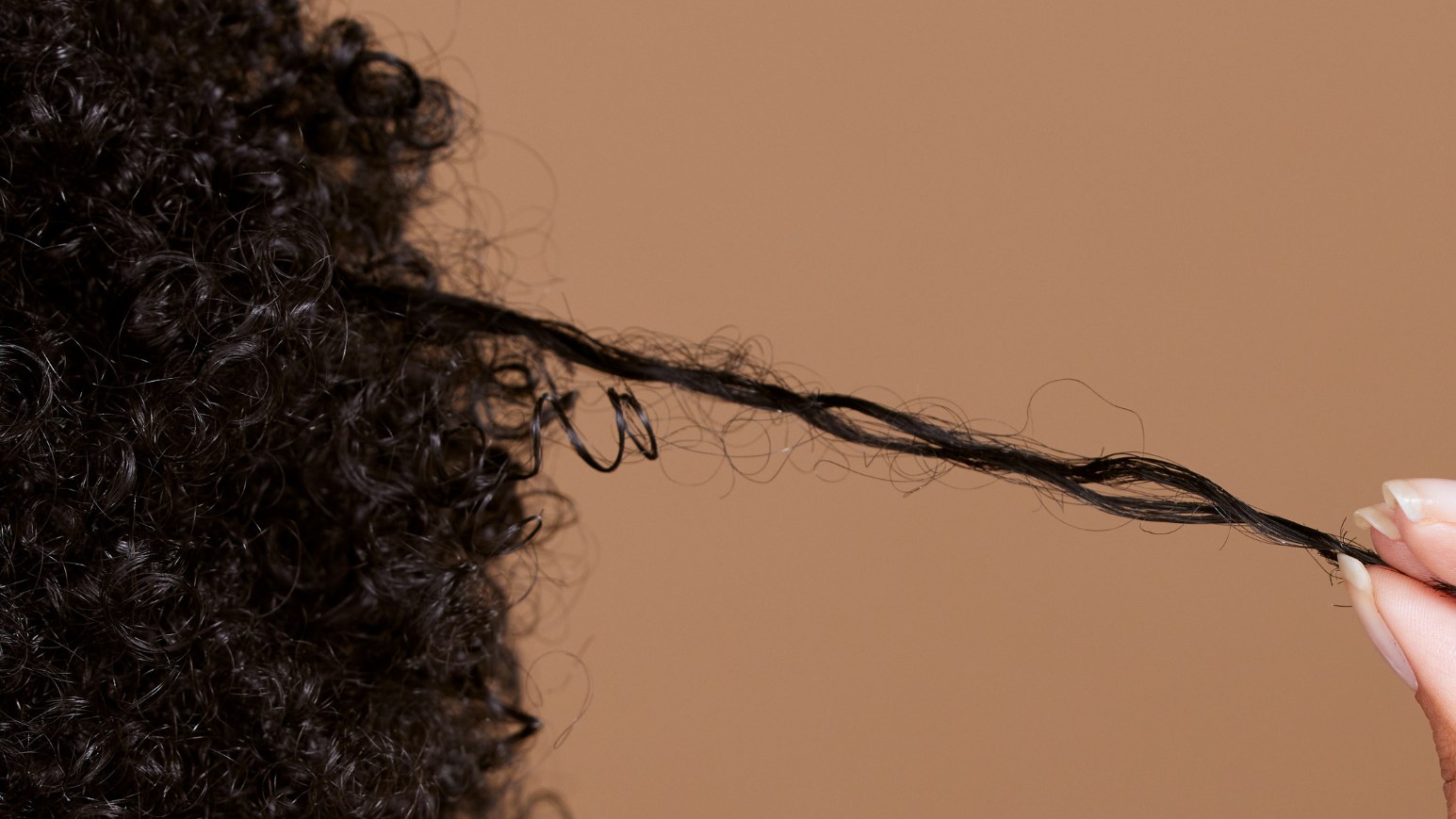
Khumalo's own interpretation was that combing African hair daily may function, for some people, as the equivalent of a daily haircut. Not a metaphor about damage. A description of what a comb does to a fibre with that particular geometry, repeated three hundred and sixty-five times a year.
This one comes with a real limitation and it needs saying: three participants is three participants. Khumalo said as much, noting the observation rests on few people and requires confirmation in larger population studies. It is a signal, not a settled fact. But it is a signal that points the same direction as the 1,042-child study, and the two together are considerably harder to dismiss than either alone.
What this changes
If you accept that growth is happening and length is leaving, your entire routine reorganises around a different target.
The old target was stimulation. Growth oils, scalp serums, inversion methods, biotin, anything that promised to make the follicle work harder. But the follicle was never the bottleneck. In the studies above, the follicle did its job for three consecutive years while visible length moved less than three centimetres.
The new target is the last few inches of every strand, because that hair is the oldest hair on your head. The ends of shoulder-length hair have survived roughly two years of washing, combing, styling, weather, friction against fabric, and every product decision you made across that entire span. They have earned the fragility they have.
Which reframes the usual suspects. Dryness, friction, over-manipulation, heat, tension styling, and rough detangling are not vague wellness villains. They are the specific list of things that remove length at the same rate the scalp supplies it. Every one of them is a retention variable, and every one of them is adjustable.
So the question stops being why isn't my hair growing.
It becomes: why am I not keeping what grows?
That question has answers. The other one never did.
Sources
Where a source has a limitation that affects how much weight it can carry, it is stated here rather than left out.
Loussouarn G. African hair growth parameters. British Journal of Dermatology. 2001.
doi:10.1046/j.1365-2133.2001.04350.xView source
The author was affiliated with L'Oreal's research laboratories, a commercial interest in hair science. Sample of 38 adults. Measures growth rate at the scalp, not length retained over time.
Khumalo NP, Gumedze F. African hair length in a school population: a clue to disease pathogenesis?. Journal of Cosmetic Dermatology. 2007.
doi:10.1111/j.1473-2165.2007.00326.xView source
Cross-sectional survey of schoolchildren rather than adult women, and time since last haircut was self-reported. The plateau it describes may not transfer directly to adult hair or to other grooming practices.
Khumalo NP. African hair length: the picture is clearer. Journal of the American Academy of Dermatology. 2006.
doi:10.1016/j.jaad.2005.08.002View source
Three participants. The author states plainly that the observation rests on few people and requires confirmation in population studies. Treat it as a signal, not a settled finding.