Braiders have been arguing about gel for years, and both sides of that argument are describing something real.
One side says gel is what makes a braid a braid. Grip at the root, crisp parts, no frizz halo by week three. The other side says gel is what turns takedown into a horror film. Buildup at the root, white flakes in the parts, strands that snap the moment they are freed.
I went looking for what the research actually supports. The answer has almost nothing to do with whether gel is used, and almost everything to do with how much, how wet, where it lands, and what is preserving it.
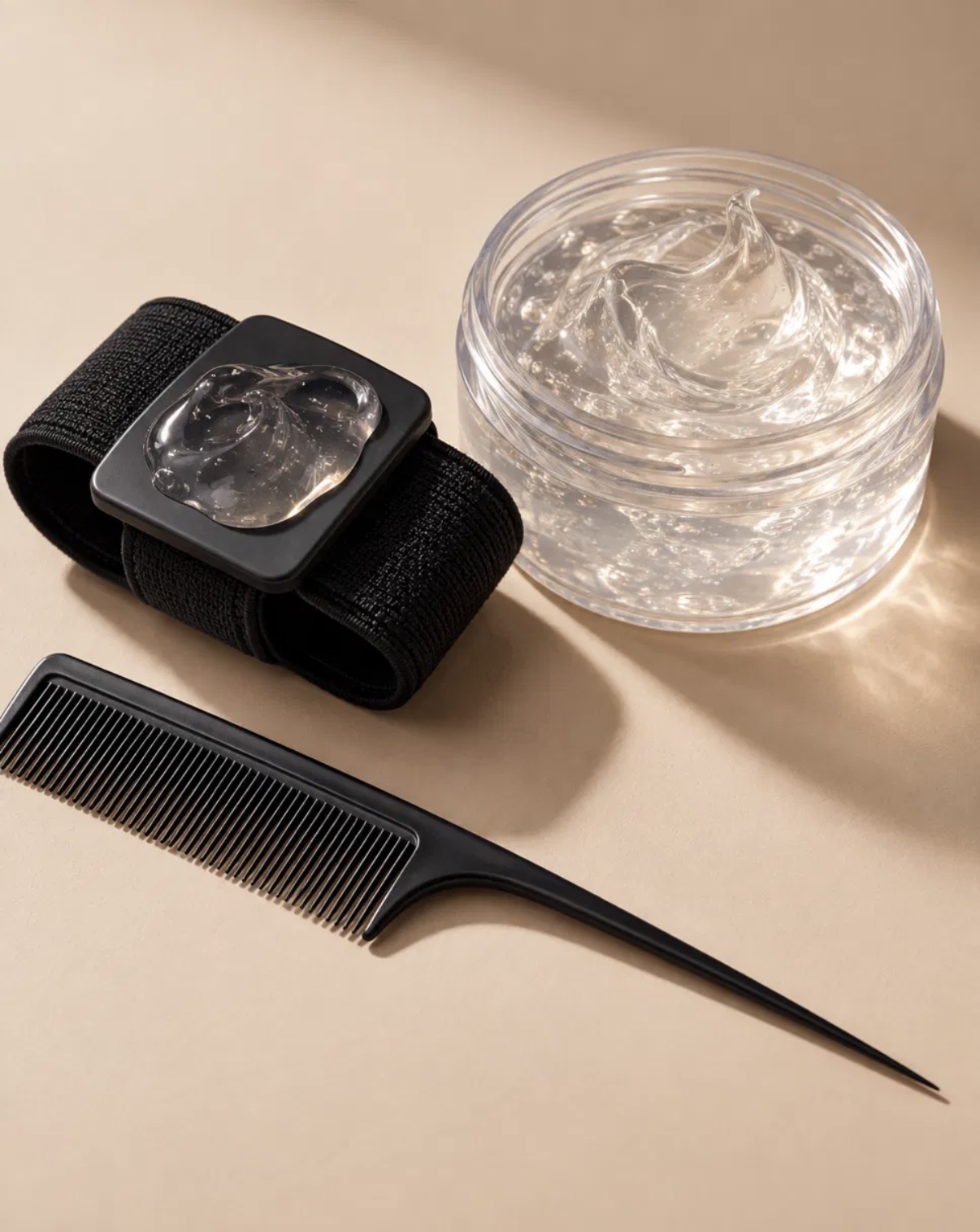
What is actually in the jar
Most braiding gels are a water base carrying a film forming polymer. Usually PVP, PVP/VA copolymer, or carbomer neutralized with triethanolamine. Then a humectant like glycerin or propylene glycol, a slip agent, fragrance, dye, and a preservative.
The polymer dries into a thin shell around each strand. That shell is the hold. It is also the thing that has to come back off.
A widely sold braid and loc gel lists its ingredients as water, PVP/VA copolymer, triethanolamine, carbomer, propylene glycol, hydrolyzed wheat protein, DMDM hydantoin, fragrance, methylparaben and propylparaben. Hold that last set of names. We come back to them.
Why braiders reach for it
The case for gel is not vanity, and it is worth stating properly before taking it apart.
Freshly washed coily hair is slick. A polymer film gives the braider something to hold, which can mean less pulling to get the same result. Gel is also how a grid stays a grid for six weeks instead of six days, and how cuticle stays lying flat instead of lifting and flying away.
There is a real health argument buried in that last point. A style that holds longer means fewer full installs, and fewer installs means less cumulative tension on the follicle over a year. The American Academy of Dermatology advises keeping braids in no longer than six to eight weeks and switching styles so the scalp can recover. Anything that gets you to week six without a redo is doing part of that work.
The gel is not what is taking your edges
This is the part of the argument that gets the blame wrong.
Traction alopecia is caused by tension on the follicle, not by product. It is the most common complication of braided styling, and it appears first at the frontal hairline and temples.
In a survey of 201 caregivers of African American girls across Detroit clinics, published in the Journal of the American Academy of Dermatology in 2011, cornrows carried an adjusted odds ratio of 5.79 for reported traction alopecia. That is nearly six times the odds, attached to the style, not to what was in the braider's hand.
Caught early, traction alopecia can recover. Once it scars, it does not. Blaming the jar lets a heavy handed install off the hook, and the install is the thing that needed changing.
Where gel genuinely does damage
Now the case against.
Occlusive styling product sitting at the follicle opening is a documented trigger for folliculitis. Heavy hair product migrating onto skin causes a comedonal eruption that dermatologists named pomade acne in a 1970 paper in the Archives of Dermatology, and it is still in the textbooks. The lesions cluster exactly where product sits against skin, along the frontal hairline, the temples and the nape.
In that same Detroit survey, girls wearing extensions reported seborrheic dermatitis at rates around twenty percent higher than girls without them.
Gel does not need to be smeared on the scalp to do this. It reaches the scalp whenever it is laid into the root of every part, which is exactly how most installs are done now.
Soaking wet is the worst time to braid
Water breaks the hydrogen bonds that give a strand its strength. That is why wet hair feels stretchy, and why it snaps.
Fiber fatigue testing at the Textile Research Institute, reported in Cosmetics and Toiletries, found that afro textured hair fails roughly ten times faster than straighter hair under the range of stresses produced by normal combing and brushing. The same testing found failure rates climb further as moisture content rises. That portion of the work is described as unpublished data, so take it as a strong signal rather than a settled number, but the direction is not in dispute.
A braider working through a saturated mix of water and gel is pulling on hair at its weakest point, for six to ten hours.
The part of this debate nobody is having
Here is the finding with the most hard evidence behind it, and almost nobody is arguing about it.
In 2023 the Washington State Department of Ecology tested fifty low cost personal care products marketed to and used by people of color. Formaldehyde turned up in 26 of the 30 body lotions and hair products tested. Broken down, that was seven of ten skin lotions, nine of ten leave in conditioners, and ten of ten hair styling gels.
Styling gels carried the highest readings in the sample, above 200 parts per million, the level at which allergic reaction becomes possible. The highest single reading in the whole study was 1,660 ppm, in an extra hold conditioning gel sold for braids, twists, locs and edges.
Formaldehyde is almost never printed on the label. It comes from a preservative that releases it over time, most often DMDM hydantoin.
This is not an isolated result. A 2025 study in Environmental Science and Technology Letters found that 53 percent of Black and Latina participants in Los Angeles used at least one personal care product containing formaldehyde or a formaldehyde releasing preservative. DMDM hydantoin appeared in 58 percent of the hair products that contained one.
Washington has since become the first state to ban formaldehyde releasing chemicals in cosmetics. That rule takes effect on January 1, 2027. There is still no federal ban.
What to look for on a label: DMDM hydantoin, diazolidinyl urea, imidazolidinyl urea, quaternium 15, sodium hydroxymethylglycinate, bronopol.
Before there was a jar
Braiding is older than any product aisle, and the question of what holds a braid has been answered many different ways.
Cornrows appear on a Nok terracotta from Nigeria dated to around 500 BCE. What held the hair was fat and earth, not polymer, and the crucial difference is that it was reapplied on a cycle rather than left to build.
In Chad, chebe powder is worked through the hair with shea butter, then braided to seal the moisture in. Across West Africa, shea butter and palm oil remain the anchor of Ghanaian and Nigerian hair ritual. In Namibia, Himba plaits are packed with otjize, red ochre blended with butterfat, which doubles as sun and insect protection. In Ethiopia's Omo Valley, Hamar women press ochre, water and butterfat into the goscha braid.
What went on the hair, decade by decade
1900s and 1910s. The American Black hair market opens around the scalp, not the style. Annie Malone founds Poro in 1902. Madam C.J. Walker begins selling Wonderful Hair Grower in 1906. The Smithsonian records its formula as petrolatum, coconut oil, beeswax, copper sulfate, carbolic acid, precipitated sulfur and perfume. Braids were worn. The product logic of the era was grease and medicated scalp treatment.
1920s and 1930s. C.D. Murray, a Chicago barber, formulates Murray's Superior in 1925 and sells it out of his own shop. The base is petroleum jelly and mineral oil, and it is famously hard to wash out. The company still recommends dish soap. Royal Crown Hair Dressing arrives in 1936 in the red tin it still uses. Hold in this era means wax and oil, applied heavily, removed rarely.
1940s and 1950s. Dixie Peach, a lighter petrolatum and lanolin pomade, is popular with the era's hair from the Second World War through the 1960s. Blue Magic and similar petrolatum dressings become the default scalp product in Black households. In 1954 George and Joan Johnson found Johnson Products in Chicago with a 250 dollar loan. Ultra Wave arrives for men, Ultra Sheen for women in 1957. The industry's center of gravity is straightening, and grease is what goes on the scalp before and after.
1960s and 1970s. Soft Sheen launches in 1964. Johnson Products releases the Afro Sheen line in the late 1960s for pick worn naturals, sponsors Soul Train, and in 1971 becomes the first Black owned company listed on the American Stock Exchange. Dark and Lovely arrives in 1972. This is also when the medical literature catches up. Pomade acne is published in 1970, and in 1975 the Federal Trade Commission requires Johnson to label its relaxers as containing lye.
1980s and 1990s. Ecoco is founded in Chicago in 1983 and brings out the first alcohol free styling gel. Water based hold arrives as an alternative to petrolatum and is marketed as the gentler choice. Box braids go fully mainstream in the 1990s. Braiders now have a product built to set a style rather than just coat a strand, and technique starts to change around it.
2000s and 2010s. The natural hair movement resurges around 2008, carried by YouTube. Relaxer sales fall by more than a quarter. Styling gels, setting lotions and curl creams rise to fill the gap. Edge control becomes its own category. In the braid chair, gel shifts from a finishing step to the base layer of the whole install, applied at the root of every part rather than smoothed down the length.
2020s to now. Knotless braids and the gel plus mousse install become the standard look. At the same time the testing starts landing. Washington finds formaldehyde in every styling gel it samples in 2023. The 2025 Environmental Science and Technology Letters study, co-authored by researchers at the Silent Spring Institute, measures formaldehyde releasing preservatives across products used by Black and Latina women.
The conversation braiders are having about gel is arriving at the same moment the data does.
So is it safe, healthy, or bad for you
Conditionally safe. Gel is a tool, and four things are true at once.
It does not cause traction alopecia. Tension does.
It is genuinely implicated in scalp disease. Occlusion at the follicle is a real and documented driver of folliculitis, seborrheic dermatitis flares and pomade style eruptions.
Volume beats brand. A jar per head is not a technique. It is usually a cover for hair that was not prepped, or a grip that was taken with tension instead.
And the label is where the strongest evidence sits. The formaldehyde releaser finding has more hard data behind it than anything else in this argument, and it is the part almost nobody is debating.
Gel becomes a problem at high volume, on soaking wet hair, packed into the scalp line, in a formula preserved with a formaldehyde releaser, and left in for two months without a wash. Change those five things and most of the argument goes away.
How to keep the gel and keep your hair
If you are in the chair
- Arrive clean, dry and fully detangled. Stretched and blow dried on low beats soaking wet.
- Ask for gel on the braid, not packed into the part line.
- Speak up when it pulls. Pain is not a technique and it is not durability.
- Six to eight weeks maximum, then rest at least two weeks before the next install.
- Wash the scalp while the style is in. Diluted shampoo to the scalp, rinse until the water runs clear.
If you are the braider
- Prep over product. Clean, stretched hair grips better than any gel does.
- Gel on the strand, not the scalp. The parts do not need to be wet to be clean.
- Do not braid saturated hair. Wet is when it breaks.
- Never use tightness as a longevity strategy. Sell the rest period instead.
- Read the preservative line before you buy the gallon size.
Educational, not medical advice
Nothing here is a diagnosis. If you have pain, pustules, spreading redness, sudden patchy loss, or a smooth shiny area where hair has stopped growing, see a board certified dermatologist. Early traction alopecia is treatable. Scarred follicles are not.
Sources
Where a source has a limitation that affects how much weight it can carry, it is stated here rather than left out.
Rucker Wright D, Gathers R, Kapke A, Kruger D, Joseph CLM. Hair care practices and their association with scalp and hair disorders in African American girls. Journal of the American Academy of Dermatology. 2011.
Survey of 201 caregivers of girls at Detroit-area clinics. Styling history was reported by a caregiver, not observed by a researcher, and the sample is one Midwestern city rather than a national one.
Plewig G, Fulton JE, Kligman AM. Pomade acne. Archives of Dermatology. 1970.
The original clinical description of the condition, more than five decades old. Later dermatology texts still cite it as the foundational reference.
American Academy of Dermatology. Hairstyles that pull can lead to hair loss. American Academy of Dermatology. 2026.
Patient education, not a study. It represents consensus clinical advice. The page carries no publication date, so the year given here is the year it was consulted.
Evans TA. Defying damage: understanding breakage in Afro-textured hair. Cosmetics and Toiletries. 2020.
Trade-press summary of fiber fatigue and combing-stress testing from the Textile Research Institute. The moisture-content failure-rate figure is described in the source itself as unpublished data, not a peer-reviewed result.
Washington State Department of Ecology. Chemicals in Cosmetics Used by Washington Residents: Report to the Legislature. Washington State Department of Ecology, Publication 23-04-007. 2023.
State testing of 50 low-cost personal care products marketed to and used by people of color, chosen in consultation with community members. This article draws the category breakdown and the 1,660 ppm reading from secondary reporting on the study rather than a direct read of the agency's PDF, which was not reachable while researching this piece.
Toxic-Free Future. High levels of formaldehyde found in personal care products, according to new report issued by the Washington State Department of Ecology. Toxic-Free Future. 2023.
Advocacy organization's summary of the Department of Ecology testing. This is the source for the 26-of-30, 7-of-10, 9-of-10 and 10-of-10 category breakdown and for identifying styling gels as the category with the highest readings.
Campaign for Safe Cosmetics. Formaldehyde and formaldehyde-releasing preservatives. Safe Cosmetics. 2026.
Consumer-facing explainer, not original research. Used here as the source for the list of formaldehyde-releasing preservative names to check on a label. No publication date is shown, so the year given here is the year it was consulted.
Dodson RE, Franklin ET, Zota AR, LaPointe Jameson R, Robinson Flint J, Edwards L, Weaver EB, Shamasunder B. Formaldehyde and Formaldehyde Releasing Preservatives in Personal Care Products Used by Black Women and Latinas. Environmental Science and Technology Letters. 2025.
doi:10.1021/acs.estlett.5c00242View source
Robin Dodson is affiliated with Silent Spring Institute, one of the study's home institutions. The full paper sits behind a publisher paywall; the figures used here are corroborated against the paper's PubMed listing and independent science-journalism coverage of it.
Toxic-Free Future. Washington becomes first state in the nation to ban all formaldehyde-releasing chemicals in cosmetics. Toxic-Free Future. 2025.
Rule adopted by the Washington State Department of Ecology. It takes effect January 1, 2027, with existing retail stock sellable through the end of that year.
OkayAfrica. A regional walk through the history of African hair braiding. OkayAfrica. 2026.
Cultural journalism, not an archaeological or academic source. The page carries no clear publication date, so the year given here is the year it was consulted.
National Museum of African American History and Culture. Annie Malone and Madam C.J. Walker: Pioneers of the African American Beauty Industry. Smithsonian National Museum of African American History and Culture. 2026.
Museum web feature. The page carries no clear publication date, so the year given here is the year it was consulted.
Murray's Superior Products Company. Company history. Murray's Superior Products Company. 1925.
Company-stated founding date and formula history. No independently published account with a stable URL was found for this entry, so it is cited by company name and founding year rather than by a link.
J. Strickland & Co.. About J. Strickland & Co.. J. Strickland & Co.. 1936.
Company history page. States that Royal Crown Hair Dressing launched in 1936 under founder George B. Long, corroborated by pomade-collector histories but not by an independent dated record.
The Pomades Blog. A Brief History of Pomades. The Pomades Blog. 2026.
Hobbyist and collector history rather than an academic or company source. Multiple independent enthusiast accounts converge on Dixie Peach's popularity running from the Second World War through the 1960s, which is the extent of what is confirmable here.
Encyclopedia of Chicago. Johnson Products Co.. Encyclopedia of Chicago. 2026.
Reference entry. The page carries no clear publication date, so the year given here is the year it was consulted.
WTTW Chicago. George E. Johnson, Black hair care pioneer and Chicago businessman who created Afro Sheen, dies at 99. WTTW Chicago. 2026.
Obituary coverage, used here for company milestones rather than for the death itself.
Block Club Chicago. The birth of Afro Sheen: how Chicago's George E. Johnson changed the Black hair game forever. Block Club Chicago. 2025.
Source for the 1975 FTC requirement that Johnson Products label its relaxers as containing lye.
Ecoco Inc.. Company history. Ecoco Inc. / Eco Style. 1983.
Company-published history. Cited for the founding year and the claim of introducing the first alcohol-free styling gel.
Black Girl Nerds. The natural hair movement through the decades. Black Girl Nerds. 2026.
Cultural journalism covering Black hair trends decade by decade, including the natural hair movement's resurgence around 2008 and box braids entering the mainstream in the 1990s. The page carries no clear publication date, so the year given here is the year it was consulted.