There is a version of this article that would be easier to write, and you have probably read it. It says that Black women get charged more at the beauty counter, calls it the pink tax, and puts a number on it.
I went looking for that number. What I found instead was that the pricing claim is shakier than almost anyone repeating it realises, and that there is a different cost, better documented and considerably harder to look at, that almost nobody puts on the receipt.
The number everybody cites
Nearly every pink tax article traces back to one source: a 2015 report from the New York City Department of Consumer Affairs called From Cradle to Cane. It compared roughly 800 products with male and female versions across two dozen retailers and found women's products cost about 7 percent more on average, rising to 13 percent in personal care. That figure drove legislation in New York and California and has been quoted continuously for a decade.
It is also thinner than its influence suggests. It is a government report rather than peer-reviewed research, prices were collected by hand, and the personal care finding rests on 122 products from three drugstores.
When researchers tested it at national scale, it did not survive intact. A study in Marketing Science used retail scanner data covering a far larger sample and matched products on their leading or active ingredients rather than on packaging. The gender price gap largely disappeared, and in several categories women's products were slightly cheaper.
The Government Accountability Office landed somewhere messier. Examining ten personal care categories in 2018, it found women's prices significantly higher in five, men's significantly higher in two, mixed results in one, and no meaningful difference in the remaining two. It also reported that it could not determine how much of that was driven by target gender, because it was unable to fully account for advertising costs and differences in what shoppers are willing to pay.
None of this means nobody has ever been overcharged for a pink razor. It means the clean, citable, 13-percent version of the story does not hold up, and a magazine that asks its readers to check sources should say so rather than repeat it because it is satisfying.
The cost that does hold up
Here is what the research does support, and it has nothing to do with the register.
In 2017, Ami Zota and Bhavna Shamasunder published a paper in the American Journal of Obstetrics and Gynecology proposing a framework they called the environmental injustice of beauty. The argument runs like this. Beauty standards are not neutral. They have historically been organised around white femininity, and meeting them requires more products, applied more often, over more years. Those products can contain reproductive and developmental toxicants. Disclosure requirements are limited and inconsistent. So the burden of chemical exposure from beauty products falls unevenly, and it falls heaviest on women of color.
That paper is a commentary rather than a study reporting new data. It is making an argument about how to read a body of existing evidence, and it should be weighed as an argument.
But the evidence underneath it is measured. In 2018, researchers published testing in Environmental Research on hair products used by Black women, looking specifically for endocrine-disrupting and asthma-associated chemicals. They were found. Not as trace contamination in outlier products, but across the category.
One limitation matters and I want it stated clearly rather than buried: testing what is in a bottle is not the same as measuring what enters a body or proving what it does there. These studies establish presence and plausible mechanism. They do not establish that any individual product caused any individual illness, and anyone telling you otherwise is running ahead of the science.
Why the exposure is unequal
The mechanism is not that anyone formulated products to be worse for Black women. It is quieter than that, and harder to fix.
Straightening was not a preference invented in a vacuum. It was a response to a world that penalised the alternative, in workplaces, in schools, and until relatively recently in the United States military. Relaxers, heat protectants, edge controls, and the layered routines that come with protective styling exist because the hair that grows out of our heads was treated as a problem to be managed.
More products, applied more frequently, over more years, to a scalp that is absorbing them. The exposure gap is downstream of a beauty standard, and the beauty standard was never about chemistry.
The word "clean" means nothing
This is the part I found most useful, and the newest.
In 2026, researchers including Zota scraped ingredient lists for 150 textured hair products from the "clean" category on the website of a single Target store in South Los Angeles. The paper's central observation is not about any particular ingredient. It is that no regulatory definition of "clean" exists at all.
The label is a marketing designation. A retailer decides what qualifies. There is no standard behind it, no enforcement, and no obligation for two products carrying it to have anything in common.
So a woman doing exactly the right thing, walking into a major retailer and deliberately choosing from the section labelled as the safer option, has no guarantee of getting one. That study covers one store's online assortment, so it describes that shelf rather than the whole market. But it describes a shelf millions of people shop.
What to actually do
I am not going to tell you to throw out your products. Most of this is regulatory failure, and putting it on individual women to shop their way out of it is how the problem stays unsolved.
What is useful is smaller. Read ingredient lists rather than front labels, because the front label is marketing and the back is the closest thing to disclosure that currently exists. Treat "clean," "natural," and "non-toxic" as design choices rather than claims, since none of them are legally defined. Be most attentive to what goes on your scalp and stays there, since leave-in products have far longer contact time than anything you rinse. And if you are pregnant, trying to conceive, or managing a hormone-related condition, this is worth raising with your doctor directly, because that is a conversation about your specific body that no article can have.
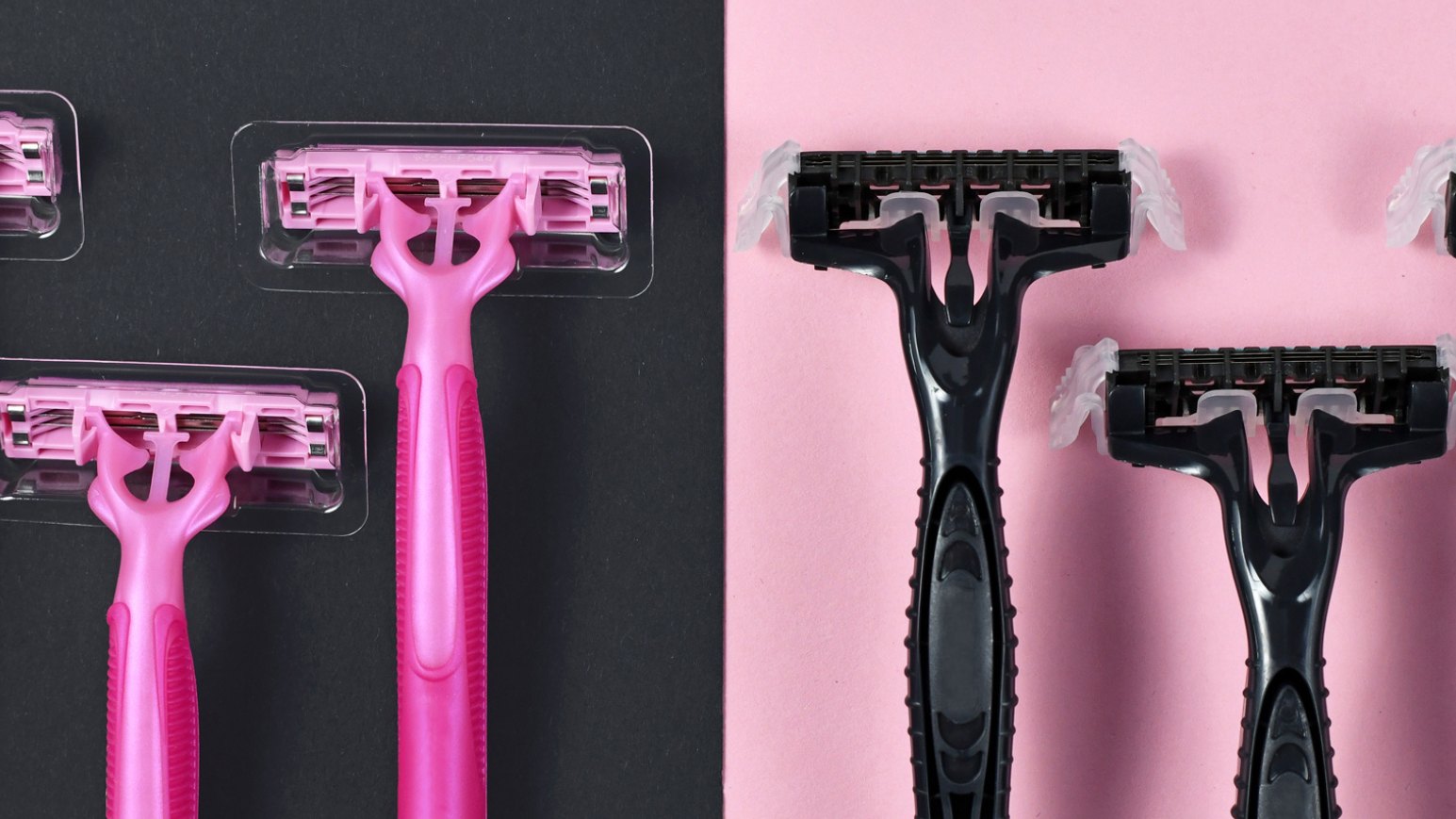
The pink tax framing survived because it is easy to picture. Two bottles, two prices, one of them pink.
The cost with actual evidence behind it does not fit on a receipt. It accumulates over decades, in a product category shaped by a standard nobody chose, sold under a word that means whatever the retailer decides. That is harder to put on a graphic. It is also the one worth knowing about.
Sources
Where a source has a limitation that affects how much weight it can carry, it is stated here rather than left out.
Bessendorf A, New York City Department of Consumer Affairs. From Cradle to Cane: The Cost of Being a Female Consumer. A Study of Gender Pricing in New York City. New York City Department of Consumer Affairs. 2015.
Government report, not peer reviewed. Prices hand-collected from roughly 800 products at two dozen New York City retailers. The personal care subset was 122 products at three drugstores.
Moshary S, Tuchman A, Bhatia N. Gender-Based Pricing in Consumer Packaged Goods: A Pink Tax?. Marketing Science. 2023.
doi:10.1287/mksc.2023.1452View source
National scanner-data analysis matching products on leading or active ingredients. Measures shelf prices only and does not address ingredient content or safety.
United States Government Accountability Office. Consumer Protection: Gender-Related Price Differences for Goods and Services. GAO-18-500. 2018.
Findings are mixed rather than one-directional. GAO states it could not fully control for advertising costs or differences in willingness to pay, so it does not attribute the differences it found to gender bias.
Zota AR, Shamasunder B. The environmental injustice of beauty: framing chemical exposures from beauty products as a health disparities concern. American Journal of Obstetrics and Gynecology. 2017.
doi:10.1016/j.ajog.2017.07.020View source
A commentary proposing an analytic framework rather than a study reporting new data. It synthesises existing findings and should be read as an argument about how to interpret them.
Helm JS, Nishioka M, Brody JG, Rudel RA, Dodson RE. Measurement of endocrine disrupting and asthma-associated chemicals in hair products used by Black women. Environmental Research. 2018.
doi:10.1016/j.envres.2018.03.030View source
Tests what is present in products, not what enters or affects the body. Detecting a chemical in a bottle is not the same as demonstrating harm to a person using it.
Zota AR, et al. Analyzing the landscape of clean products for textured hair at a Los Angeles Target. Journal of Exposure Science and Environmental Epidemiology. 2026.
Ingredient lists web-scraped from the online listing of a single store, so it reflects one retailer's assortment rather than the national market.